
When international stone buyers think of Iran, they tend to think in terms of stone names — Pietra Gray marble, Gohare limestone, Azna crystal — without necessarily knowing where these stones come from, why they come from those specific locations, and what that geography means for quality, pricing, and supply reliability. Understanding the answer to these questions leads to one place: Lorestan province in western Iran.
Lorestan is a mountainous province of 28,394 km² in the western Zagros range, with its capital in Khorramabad. It is one of Iran's oldest continuously inhabited regions — Lorestan bronze artifacts from the 3rd–4th millennia BC are considered among the finest metalwork of the ancient Near East, and the province is so historically significant that it holds one of only four main sections of the National Museum of Iran. But Lorestan's most commercially important contribution to the modern world is its extraordinary concentration of premium natural stone deposits.
According to scientific evaluation, Lorestan province holds approximately 3% of the world's decorative stones. That figure, in a province of 28,000 km² within a country of 1.6 million km², represents a remarkable concentration of global stone resources in a single geographical area — and it is the foundation on which Iranmarbles' entire operation is built.
Iran's Position in the Global Stone Market
To understand why Lorestan matters, it helps first to understand Iran's position in the global stone industry.
Iran is the third largest stone producer globally and the second richest country in the world in terms of natural stone resources, especially marble. It ranks first in the world with 4.7 million tonnes of natural stone resources when it comes to the variety of stones, colors, quality, and processing.
Marble is the most exported stone from Iran, accounting for 60 percent among other natural stone exports.
Within this global context, Iran ranks eighth globally in the export of various types of stones, accounting for approximately 3% of the total import capacity of destination countries. Iran exports stones to Oman, Qatar, Turkey, India, Russia, China, Italy, Canada, and Australia — a genuinely global distribution that reflects both the quality and the commercial maturity of Iranian stone exports.
According to Marmomacc stone trade event reports, Iran is described as "a stable and reliable player in the Middle East" with plans to ramp up production capabilities.
The global natural stone market itself is substantial and growing: the global natural stone and marble market size was valued at USD 44.54 billion in 2024 and is projected to grow at a CAGR of 4.3% through 2033, driven by Asian infrastructure development and luxury construction demand. Iran's stone industry is positioned to capture a growing share of this expanding market — and Lorestan province is its most productive engine.
The Zagros Mountain Belt: The Geological Foundation
Everything about Lorestan's stone wealth begins with geology. The province sits within the Zagros mountain belt — one of the world's great geological formations, stretching approximately 1,800 km from southeastern Turkey through western and southern Iran to the Strait of Hormuz. The Zagros range was formed by the collision of the Arabian plate with the Central Iran plate, a process that began in the Mesozoic era and continues geologically today.
This collision produced two distinct geological zones within Lorestan that are directly relevant to its stone resources:
The Sanandaj-Sirjan Metamorphic Zone
The northeastern part of Lorestan, covering the area between Boroujerd and Dorud in the north, falls within the Sanandaj-Sirjan zone — a metamorphic belt that experienced intense heat and pressure during the Arabian-Iranian plate collision. The Sanandaj-Sirjan zone contains alternating Middle Triassic-Paleozoic deposits including gray limestone and marble.
This is the geological zone that produced Lorestan's metamorphic marbles — including the crystal marble deposits of Azna and Aligudarz. The intense metamorphic transformation recrystallized original limestone into the fine-grained, highly polishable, bright-white crystal marble that has made these quarries internationally famous.
The city of Azna sits approximately 24 km from Dorud — directly within this metamorphic zone. The Aligudarz crystal quarries are in the same region. The crystalline marble mine in the Shaqez area of Aligudarz town has estimated reserves of approximately 100 million tons — a geological resource of extraordinary scale.
The Zagros Sedimentary Zone
The western and central parts of Lorestan — covering the areas around Khorramabad and extending westward — fall within the Zagros sedimentary zone, characterized by thick sequences of limestone, dolomite, and calcareous sedimentary rocks deposited in ancient marine environments.
This is the zone that produced Lorestan's sedimentary limestones — including the massive Gohare limestone deposits around Khorramabad and the Patris limestone quarries. These stones were laid down as marine sediments over millions of years and subsequently uplifted by Zagros folding into the accessible mountain exposures that Iranian quarry operators extract today.
The quality of Lorestan's sedimentary limestones reflects the purity of their marine depositional environment and the subsequent geological compaction they experienced — older, more deeply buried formations (like Gohare) having achieved greater density and lower porosity than younger, more recently formed limestones (like Patris).
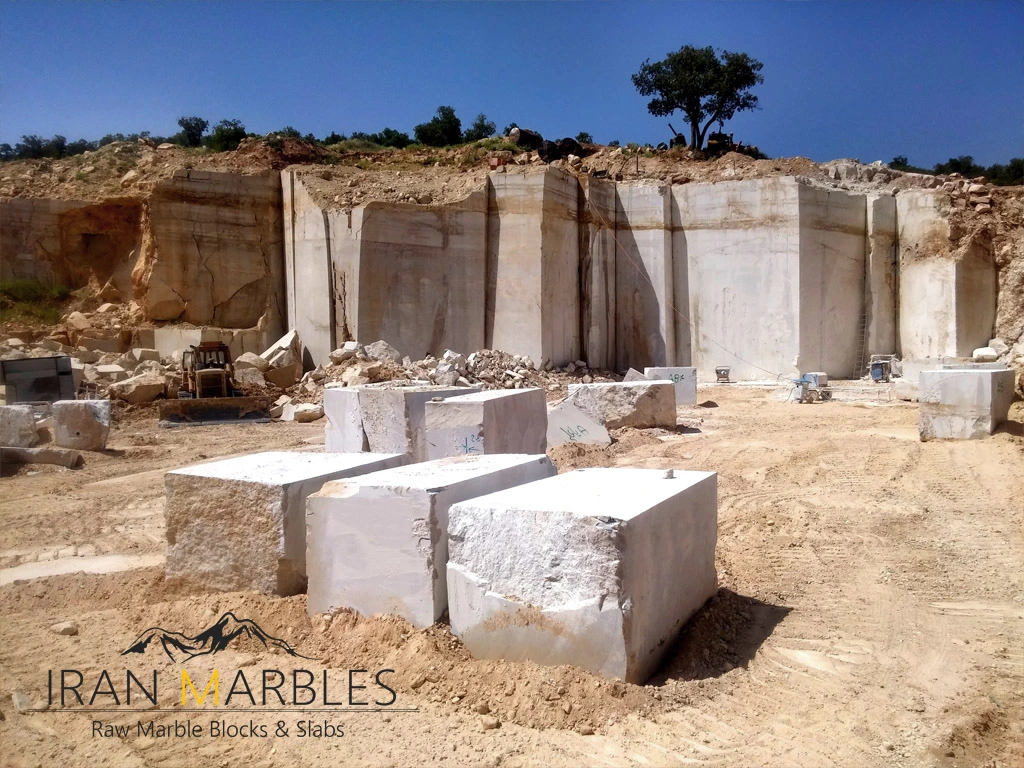
The Stone Quarries of Lorestan: A Province-Wide Map
What makes Lorestan truly exceptional in global stone production terms is not just the presence of high-quality stone — many regions have that. It is the density and variety of premium stone types within a compact geographical area. All of the following stones are quarried within approximately 200 km of Khorramabad city:
Khorramabad and surroundings — Limestone capital of Iran
Khorramabad, the provincial capital, is the best-known source of Gohare limestone — Iran's most commercially important export limestone and one of the most widely specified beige limestones in global construction markets. The Gohare quarries sit adjacent to the city, their proximity giving direct-access suppliers like Iranmarbles immediate supervision over extraction, grading, and block selection.
The scale of Gohare limestone resources around Khorramabad is substantial — the quarries have been in continuous commercial operation for over 75 years and remain far from exhaustion. Their consistent supply capacity is a key reason why Gohare limestone is specified for infrastructure-scale projects (airports, government buildings, large hotel complexes) that require guaranteed multi-year supply continuity.
Patris gray limestone is also quarried in Khorramabad — a younger, more porous formation that produces the distinctive snakeskin-patterned stone marketed internationally as Dragon limestone and Boujan silver limestone.
Azna — The white crystal marble zone
The city of Azna, located approximately 24 km from Dorud in northeastern Lorestan within the Sanandaj-Sirjan metamorphic zone, is the source of Azna white crystal marble — Iran's most internationally recognized crystal marble. The Azna quarries produce multiple faces of white crystal marble, each with slightly different color character from pure white to golden-highlighted varieties.
Oshtrankooh mountain, with an altitude of 4,150 meters, is the highest point of Lorestan province, located between the cities of Dorud, Azna, and Aligudarz — the same mountain region that hosts the metamorphic stone deposits that produce Azna and Aligudarz crystal marble.

Aligudarz — The crystal variety hub
Aligudarz, one of Lorestan's most important cities and formerly part of the Aligudarz district before becoming independent, is located in the same northeastern metamorphic zone as Azna. Its quarries produce Aligudarz white crystal marble in extraordinary variety — Persian Scato, Bianco, Panda, Gray, and other named varieties — from multiple quarry faces across the Shaqez area and Erdar Road zone.
The estimated 100 million ton reserve of crystalline marble at the Aligudarz mines places it among the most significant marble quarry zones in the Middle East — large enough to supply international markets reliably for generations.
Kermanshah province — The beige marble zone
While not technically within Lorestan, Kermanshah province shares its border directly with Lorestan — so close geographically that Iranmarbles' Khorramabad facility has comparable access to both Lorestan and Kermanshah quarries. The Harsin marble quarries near Harsin city, Kermanshah — source of Harsin beige marble — are within the broader Zagros mountain belt and represent the premium beige metamorphic marble complement to Lorestan's limestone and crystal stone resources.
Isfahan province — The Pietra Gray zone
The only Iranmarbles product that comes from outside the Lorestan-Kermanshah corridor is Pietra Gray marble — quarried exclusively in the Lashotor district approximately 35 km south of Isfahan in central Iran. While Isfahan is not adjacent to Lorestan, the established export infrastructure from Bandar Abbas port serves both regions efficiently.

The Iranmarbles Supply Advantage: What Proximity to Quarries Actually Means
Iranmarbles (Kaniyar Sang Zagros) was established specifically in Khorramabad, Lorestan — not by coincidence, but because of the extraordinary concentration of stone resources in this location. The company's 20,000 m² storage and operations facility in Khorramabad's Industrial Park places it:
- Adjacent to the Gohare and Patris limestone quarries in the Khorramabad area
- Within 50 km of the Azna crystal marble quarries near Dorud
- Within 50 km of the Aligudarz crystal marble quarries in northeastern Lorestan
- Within easy transport distance of the Harsin marble quarries in neighboring Kermanshah province
This geography is not merely a logistical convenience — it creates fundamental competitive advantages that translate directly into better value for buyers:
First-selection at the quarry face
When a stone company is located adjacent to its quarries, its experts can visit active extraction faces regularly — sometimes daily during active extraction periods. This means blocks are assessed for grade, color, and dimensional quality at the point of extraction, before they are transported to storage. Blocks that do not meet export standards are identified and separated early, rather than discovered after expensive transport and storage.
For buyers, this translates into more consistent grade quality and fewer surprises when containers are opened at the destination port.
Elimination of intermediary transport costs
Stone blocks are extremely heavy — a single block can weigh 8–15 tons. Every kilometer of transport adds cost. A supplier located adjacent to its quarries eliminates the inland transport cost that a supplier sourcing from distant quarries must absorb — and this cost difference flows through directly to FOB pricing. Due to the vicinity of stone block storages of Iranmarbles to marble stone quarries, our experts have precise supervision on the extraction of stone blocks with the highest quality possible. Our company's whereabouts and direct access to quarries eliminate intermediates, which has a significant impact on price reduction.
Rapid response to specific buyer requirements
When a buyer requests a specific color range within a grade, a particular block size, or a special characteristic (e.g., Aligudarz Persian Scato variety specifically, or Gohare exportable quality blocks above 2 m in length), a quarry-adjacent supplier can respond within days — visiting the quarry face, identifying available stock, and photographing it for buyer approval. A distant trading company relying on third-party quarry operators cannot offer this responsiveness.
Supply continuity across seasons
Lorestan's quarries operate year-round in most weather conditions, but extraction rates vary. A supplier with a large on-site storage yard — Iranmarbles operates 20,000 m² — maintains buffer stock that ensures order fulfillment continuity even during periods of reduced extraction. Buyers placing large orders can be assured of fulfillment from stored stock rather than depending on the timing of active quarry operations.

The 200 km Stone Corridor: Geography as Competitive Advantage
Perhaps the most remarkable aspect of Lorestan province as a stone sourcing region is the concentration of completely different stone types within a 200 km radius. Consider what a buyer can source from a single Khorramabad-based supplier:
| Stone | Type | Quarry location | Distance from Khorramabad |
|---|---|---|---|
| Gohare Beige Limestone | Sedimentary limestone | Khorramabad, Lorestan | Adjacent — <10 km |
| Patris Gray Limestone | Sedimentary limestone | Khorramabad, Lorestan | Adjacent — <10 km |
| Azna White Crystal | Metamorphic crystal marble | Azna, Lorestan | ~50 km |
| Aligudarz White Crystal | Metamorphic crystal marble | Aligudarz, Lorestan | ~80 km |
| Harsin Beige Marble | Metamorphic marble | Harsin, Kermanshah | ~120 km |
| Pietra Gray Marble | Metamorphic marble | Lashotor, Isfahan | ~450 km (via Bandar Abbas) |
Four of the six Iranmarbles products originate within 80 km of the Khorramabad facility. Five are within 120 km. This concentration is what enables a single supplier to offer such a broad range of stone types — from sedimentary limestone to metamorphic marble to white crystal — with genuine quarry-level quality control across all of them.
No other stone-producing region in Iran — and very few globally — offers this combination of variety, quality, and geographical concentration. The Lorestan stone corridor is genuinely unique.
Lorestan's Geological Heritage: Stone That Built History
Lorestan's relationship with stone is ancient. The province is one of the earliest human settlements in the Iranian plateau — according to archaeological findings, Lorestan is one of the first ancient human settlements and Lorestan bronze has a great archaeological reputation. Lorestan is the only province in Iran that has one of the four main sections of the National Museum of Iran due to its extraordinary historical importance.
The same mountains that produced the bronze-age artifacts now housed in national museums have been producing building stone for millennia. Lorestan limestone and marble appear in ancient Persian architecture across western Iran — the same geological formations that Iranmarbles extracts for international export today have been valued by builders and craftspeople for thousands of years.
This deep connection between Lorestan's landscape and its stone heritage is not merely historical context — it is an authentic brand story. When international buyers specify Iranian stone from Lorestan, they are specifying material from one of the world's most ancient stone-working regions, with a geological patrimony that stretches from the ancient Near East to the contemporary global market.
Why Lorestan Matters for Your Stone Sourcing
For international buyers evaluating Iranian stone suppliers, understanding Lorestan's geological and geographical significance has direct practical implications:
Prefer quarry-adjacent suppliers. A supplier based in Khorramabad with direct quarry relationships across Lorestan will consistently offer better quality control, faster order fulfillment, and more competitive FOB pricing than trading intermediaries sourcing from the same quarries at a distance.
Recognize that variety and proximity are related. The breadth of the Iranmarbles product range — six distinct stone types across limestone, marble, and crystal categories — is a direct consequence of Lorestan's geological diversity and the company's proximity to multiple quarry zones. Buyers who need complementary stones for a single project (dark marble + beige limestone + white crystal, for example) can source all three from a single Lorestan-based supplier with matching lot control.
Understand that the Lorestan brand is real. When suppliers reference "Lorestan limestone," "Lorestan crystal marble," or "Khorramabad limestone," they are invoking a genuine geographical indication of quality — comparable in its market function to the way "Carrara" or "Botticino" signals origin quality for Italian marble. Lorestan-origin stone, from established Lorestan suppliers, carries a quality expectation that is recognized across global stone markets.

Related articles:

Patris Gray Limestone: The Young Stone Redefining Modern Facades and Interiors

Harsin Beige Marble: Iran's Warmest Marble and Its Global Applications
Persian Crystal Marble: Complete Guide to Azna and Aligudarz White Crystal Stones
How to Import Natural Stone Blocks from Iran: A Step-by-Step Guide for Buyers
Frequently Asked Questions
Why is Lorestan the most important stone-producing province in Iran?
Lorestan holds approximately 3% of the world's decorative stone resources within a single province — an extraordinary concentration that reflects the province's geological position within both the Zagros sedimentary belt (producing limestone) and the Sanandaj-Sirjan metamorphic zone (producing marble and crystal marble). The combination of two distinct geological zones within one compact geographical area produces a uniquely broad range of stone types — from the dense Gohare beige limestone to the metamorphic Azna and Aligudarz crystal marbles — all within approximately 80 km of Khorramabad.
What is the geological reason for Lorestan's stone quality?
Lorestan's sedimentary limestones (Gohare, Patris) were deposited in ancient marine environments and subsequently compacted by geological uplift within the Zagros fold belt — producing dense, high-quality limestones. Its metamorphic marbles (Azna, Aligudarz crystal) were formed in the Sanandaj-Sirjan zone where intense heat and pressure from the Arabian-Iranian plate collision recrystallized original limestone into fine-grained, highly polishable crystal marble. Both geological processes produced commercially valuable stones.
How large are the Aligudarz crystal marble reserves?
The crystalline marble mine in the Shaqez area of Aligudarz town in Lorestan province has estimated reserves of approximately 100 million tons — sufficient to supply international markets at current extraction rates for generations. Gohare limestone reserves around Khorramabad are similarly substantial, with over 75 years of active commercial extraction history and no signs of near-term depletion.
Where is Iranmarbles located in Lorestan?
Iranmarbles (Kaniyar Sang Zagros) is located in the Industrial Park of Khorramabad, the capital of Lorestan province, at coordinates approximately 33.49°N, 48.36°E. The facility covers 20,000 m² of storage and operations space. Khorramabad is directly adjacent to the Gohare and Patris limestone quarries, approximately 50 km from the Azna crystal quarries, and approximately 80 km from the Aligudarz crystal quarries.
Why does quarry proximity matter when choosing a stone supplier?
Proximity to quarries enables first-selection grading at the quarry face (before blocks are moved), eliminates intermediary transport costs that inflate FOB pricing, enables rapid response to specific buyer requirements (variety, color range, block size), and allows maintenance of buffer stock that ensures supply continuity. A supplier located adjacent to its quarries consistently offers better quality control, faster fulfillment, and more competitive pricing than a trading intermediary sourcing from the same quarries at a distance.
What stones from Lorestan does Iranmarbles supply?
Iranmarbles supplies four Lorestan-origin stones: Gohare Beige Limestone and Patris Gray Limestone from the Khorramabad quarries, and Azna White Crystal and Aligudarz White Crystal from the metamorphic quarries of northeastern Lorestan. We also supply Harsin Beige Marble from neighboring Kermanshah province and Pietra Gray Marble from Isfahan province.
Explore Iranmarbles' Lorestan Stone Range
Iranmarbles (Kaniyar Sang Zagros) has operated from Khorramabad, Lorestan since 2004 — sourcing, grading, and exporting natural stone blocks from the quarries of the Lorestan and Kermanshah regions to buyers in China, Turkey, Italy, India, the USA, Greece, and beyond.
Our complete product range from the Lorestan corridor: Gohare Beige Limestone — FOB from $112/ton — Khorramabad quarries; Patris Gray Limestone — FOB from $99/ton — Khorramabad quarries; Azna White Crystal Marble — FOB from $157/ton — Azna, Lorestan; Aligudarz White Crystal Marble — FOB from $162/ton — Aligudarz, Lorestan; Harsin Beige Marble — FOB from $125/ton — Harsin, Kermanshah; Pietra Gray Marble — FOB from $220/ton — Lashotor, Isfahan.
To request samples, technical documentation, or a Proforma Invoice for any of our products, contact our sales team at info@iranmarbles.org or WhatsApp +98 935 700 0285.